
How to Do Cold Outreach in 2026: The Unsentimental Guide
By Pitchlane team · March 13, 2024 ·

To do cold outreach that works, send fewer emails to a tighter list, keep the first one under 80 words, follow up three times with something new each time, and give the prospect something that visibly couldn’t have gone to anyone else. A realistic reply rate from humans is about 1% of emails sent. That’s what we and our customers see, and Belkins measured 0.45% across 7.5 million cold emails in 2025 once auto-replies and bounces were stripped out. Vendor benchmarks run far higher: Instantly’s 2026 report says 3.43%, but it counts every reply, out-of-office included, and only the campaigns on its own platform. Budget on 1%, and treat anything above 3% as a result worth protecting. Your copy is rarely what separates the two. Your reply rate is low because your email looks like the other 40 they got today.
Cold outreach means contacting people who don’t know you and haven’t asked to hear from you. It’s still the fastest way to create pipeline on demand, since you pick who you talk to and can start tomorrow. It’s also become a game of not looking like everybody else, and everything below serves that goal.
The maths you are actually playing
Take 1,000 leads at a realistic 1%. That’s 10 human replies, maybe half of them interested, so 5 real conversations and perhaps 2 meetings. At Belkins’ 0.45% floor it’s 4 or 5 replies and you’re hoping for one meeting. Those are our round assumptions, so plug in your own in the cold email ROI calculator.
Now get the same list to 3%. That’s 30 replies, about 15 positive and 6 meetings. Tripling your reply rate gives you the same meetings as sending 2,000 more emails, and burning through that much data is what wrecks your domains and your market.
Volume is the most overrated lever in outbound. Every unworked lead in your total addressable market is an asset, and sending a weak campaign to them spends that asset for nothing.
Step 1: Build a list worth emailing
Most “copy problems” are list problems. Before writing a word, write down the event that makes someone need you now: a new VP of sales, a Series A, a hiring spike for SDRs, a product launch, a competitor contract ending. A list of 300 companies that had the event beats 5,000 that fit a persona.
Pull with Apollo or Clay, verify every address, and add one column you’ll need later: the URL you want behind you in the video. Their homepage is the default. Their LinkedIn profile or a specific product page works too.
Step 2: Protect your deliverability first
Send from secondary domains, never your main one, with SPF and DKIM set up, and warm them before the first campaign. Watch the spam rate: Google says stay under 0.1% and treats 0.3% as the danger line. Then cap each inbox at a volume that looks human.
The law is simpler than people make it sound. In the US, CAN-SPAM doesn’t require consent. It requires an honest sender and subject line, a postal address and a working opt-out honoured within 10 business days, with penalties up to $53,088 per email. Canada and much of the EU are stricter, and Germany in particular treats unsolicited email as requiring prior consent. So know your market, and run a suppression list across every tool you use.
Step 3: Write the email nobody else is sending
You’ve received this one a hundred times:
Hi {{first_name}}, I hope this message finds you well. I’m Sam from Acme, where we specialize in streamlining operations. I noticed {{company}} has been doing great things, congratulations! I believe our platform could help enhance your efficiency. Would you be open to a brief call next week?
Every clause in it is about the sender or could apply to anyone. It also asks for 30 minutes from a stranger who has seen no evidence.
Here’s the same pitch at 58 words, built on a trigger:
Subject: SDR hiring at {{company}}
{{first_name}}, saw you’ve got three SDR roles open. Usually that means pipeline’s behind plan and the fix is more dials.
We got a 40-person SaaS team the same meetings with one rep and a smaller list. I recorded a minute on how, with your site in the background: {{video_gif}}
Worth a look?
It’s short, which matters: the highest-performing senders average under 80 words. It names a reason for writing today, offers proof and asks for almost nothing. Run it past the spam words checker and vary it with spintax so 1,000 copies don’t look identical to Gmail.
Step 4: Use video to look like the only human in the inbox
Video does the job text can’t: it proves you’re real, and a person’s face is hard to ignore. Hand-recording doesn’t scale, though. Recording 200 Looms by hand is a job, not a strategy, and at two minutes a take plus admin you’ve lost a working week.
Pitchlane renders the whole list from one take. You record your pitch once as a talking-head bubble. Each prospect sees that recording over their own website, scrolling behind you. Each one gets a landing page with your calendar on it and a personalised thumbnail GIF for the email. The recording is the same for everyone, and their name goes in the email and the video title.
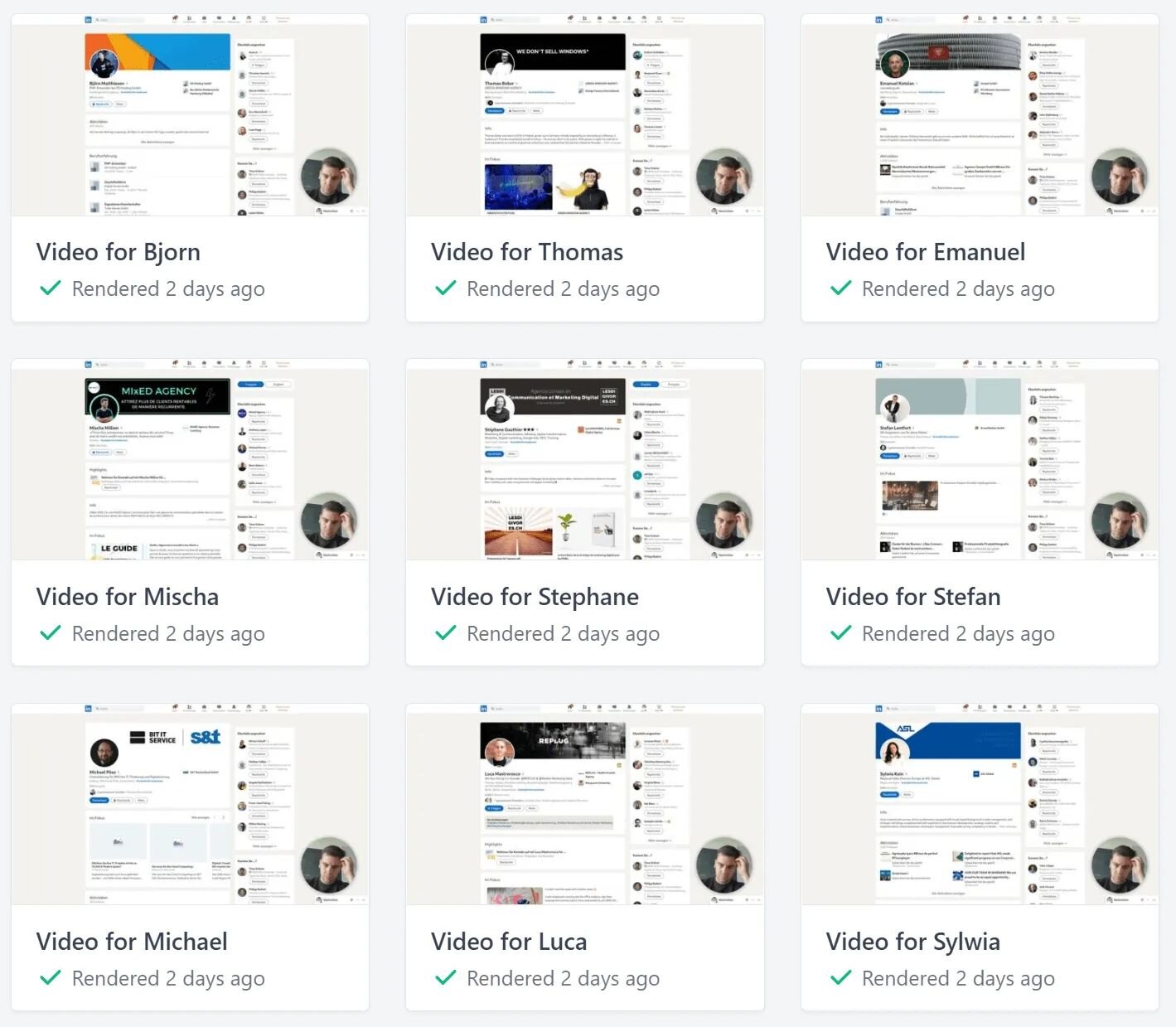
Script it so the reuse doesn’t show: talk about a problem everyone on that list shares, and acknowledge the background once (“that’s your site behind me”). Keep it around a minute. Our video pitch guide has a full script, and the video prospecting guide goes deeper on the method.
Does cold video outreach work? Ask the people who ran it. Bram booked 18 meetings from 140 contacts. Safwan went from a 1% to a 6% positive reply rate. Hoani holds a 5% meeting-book rate at scale. And Erik Paulson’s agency, below, saw 300% more meetings booked. Their results, their lists, their offers, and all several times the 1% a realistic campaign gets.

Step 5: Run four touches, then stop
58% of replies come from the first email and 42% from follow-ups, so a one-shot campaign throws away four replies in ten. Instantly’s sweet spot is four to seven touches, while SmartReach’s 2026 data shows returns bending after the third or fourth and reputation paying for the rest. We’d stop at four.
| Day | Channel | What it says |
|---|---|---|
| 0 | The trigger email above, with video if your domain is warmed. On a fresh domain, go plain text and save the video for day 3 | |
| 3 | New angle, same thread: “the part I left out” with one customer result. Video viewers skip this and get a personal note | |
| 7 | LinkedIn or phone | Connection request with no pitch, or a call to anyone who watched |
| 14 | The breakup: “Not a priority? Say so and I’ll close this out. If timing’s the issue, tell me when” |
Each touch needs to carry something new. Bumping the thread with “just following up” isn’t a follow-up, and everyone can tell.
The strongest proof of that is Allie Janoch’s pair of emails to Jason Lemkin of SaaStr. Here’s the first, from 2015:
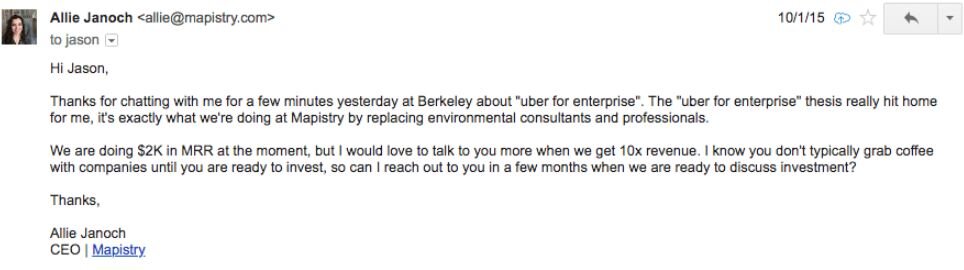
It went nowhere. Two years later she wrote again, this time with her subject line naming her Fortune 500 customers, and a body full of numbers:
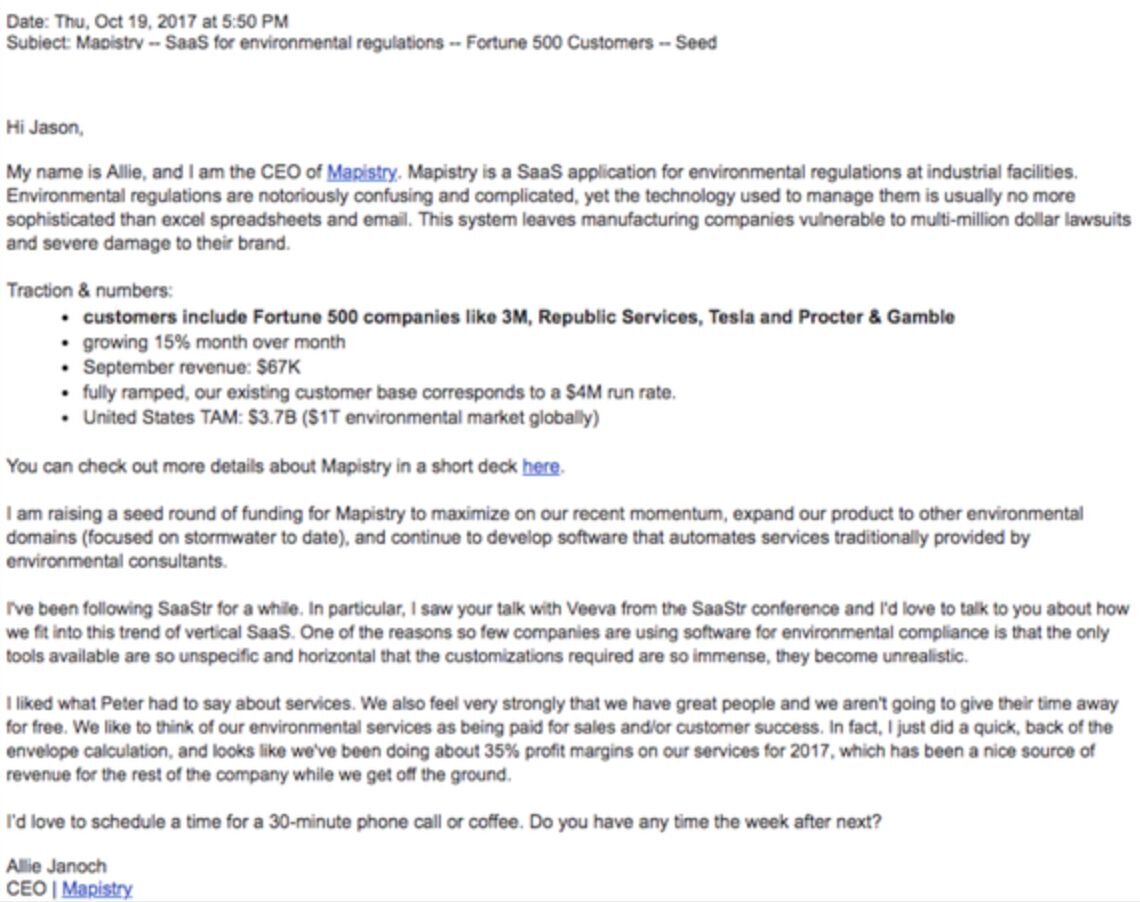
That one led to a $2.5M seed round, and she got a 33% hit rate from that template across other investors. The lesson goes beyond “follow up”. She followed up when she had something new to say, and it was the evidence that opened the door.
Which cold outreach channel should you lead with?
Lead with email, because it’s the cheapest per conversation and carries video and links without friction. Layer the phone on your best 20% of accounts and anyone who watches a video.
| Channel | The real numbers | Where it wins |
|---|---|---|
| About 1% of sends get a human reply; 0.45% at Belkins, 3.43% on Instantly’s own platform with auto-replies counted | Volume, proof, video links, tracking | |
| Phone | 2.7% of conversations booking a meeting, 82-second calls on average | Hot accounts, the follow-up to a video view |
| No reliable public benchmark exists | Senior buyers, and showing your face before the email lands |
The sequencing beats any single channel. A prospect who saw your face in a video on Tuesday answers an unknown number differently on Thursday.
Measure what pays
Track four things per campaign: positive reply rate, meetings booked per 100 leads, cost per meeting and spam rate. Ignore opens entirely, since Apple’s mail privacy has turned them into noise. With Pitchlane you can add a real signal: who watched, who finished, who clicked. A watcher who didn’t reply goes on a call list, which is the highest-value list you’ll ever have.
Change one thing at a time, on at least a few hundred sends, starting with the list, then the offer, then the first line. Subject lines come last. Teams usually test them first because they’re easy, and that’s why they keep testing them.
Put your face on your next campaign
If you run outbound now, you already have the list and the sender. Pitchlane plugs into them: Instantly and Smartlead directly, and lemlist, HubSpot, Apollo and 20+ others by CSV, webhook or Zapier.
Take your best-performing campaign, record a one-minute pitch and render it against the next 250 leads with the 14-day free trial. Run it against the same copy with no video. You’ll have your own number inside two weeks, and it’ll tell you more than any benchmark on this page.
Questions
Frequently asked questions
What does cold outreach mean?
Cold outreach means contacting someone who has had no prior relationship with you and has not asked to hear from you, usually by email, phone or LinkedIn, with the aim of starting a sales conversation. It differs from inbound, where the prospect comes to you, and from nurture, where they have already shown interest.
How do you do cold outreach step by step?
Build a list around a trigger event, protect deliverability with secondary domains and warm-up, write a first email under 80 words that could only have gone to that person, add a personalized video so you look human, and run four touches over two weeks with something new in each. Then measure replies and meetings, never opens.
What is a good cold outreach reply rate?
About 1% of emails sent getting a human reply is realistic, and Belkins measured 0.45% across 7.5 million emails once auto-replies were removed. Anything above 3% is a result worth protecting. Vendor benchmarks like Instantly's 3.43% count every reply on their own platform, out-of-office included, so do not budget on them.
What is a cold audience?
A cold audience is a group of people who match your ideal customer but have never heard of you. They need a reason to care in the first line, since they have no existing trust in your name. The fastest way to earn it is to show you did work on them specifically, which is what their website behind your face does.
Does cold video outreach work?
Yes, when the video is clearly made for the recipient and short. Bram booked 18 meetings from 140 contacts, Safwan went from a 1% to a 6% positive reply rate and Hoani holds a 5% meeting-book rate at scale, all with Pitchlane videos in their cold sequences. Those are their results, several times what a realistic text-only campaign gets.
Is cold outreach the same as spam?
Spam is unwanted bulk mail with no relevance to the reader. Cold outreach done properly goes to a researched list, identifies the sender, offers a way out and stops when asked. The line is relevance, and your spam complaint rate will tell you which side you are on; Google treats 0.3% as the danger line.
Is cold outreach legal?
In the US, yes under CAN-SPAM, provided the sender and subject are honest, you include a postal address and a working opt-out, and you honour it within 10 business days; penalties run up to $53,088 per email. Canada's CASL and much of the EU are stricter, and Germany in particular expects prior consent, so know each market before sending.
How many follow-ups should a cold outreach sequence have?
Four touches, then stop. Instantly's data shows 42% of replies arrive after the first email, so one shot throws away nearly half, but SmartReach's 2026 data shows returns bending after the third or fourth touch and sender reputation paying for the rest. Every follow-up needs new information; a bump saying just following up is not a follow-up.
Cold email vs cold calling: which works better?
Lead with email for volume, proof and video links, then put the phone on your best 20% of accounts and anyone who watched your video. Industry-wide only 2.7% of cold-call conversations end in a meeting, and the average call lasts 82 seconds. The sequence beats either channel alone: a face seen on Tuesday answers an unknown number differently on Thursday.
How do I personalize cold outreach without recording a video for every prospect?
Record one pitch and let software change the background per lead. Pitchlane plays your recording as a talking-head bubble over each prospect's own website, with their name in the email and the video title, and renders the whole list from a single take. Hand-recording 200 Looms is a job, not a strategy.