
10 Sales Prospecting Techniques, Ranked by What They Actually Return
By Pitchlane team · March 13, 2024 ·

The best sales prospecting technique is getting introduced by a customer. The best one for a cold list is sending each person a video with their own website behind you. Plain cold email, the method most teams spend the most on, ranks eighth, and the AI-written first lines bolted onto it are last.
Most lists of sales prospecting techniques pad themselves out with “know your ICP” and “understand your USP”. Those are homework, and you should’ve done them already. Here are ten things you can actually run, ordered by how we’d spend the next hour and the next dollar.
Sales prospecting techniques compared by the numbers
Every channel reports results with a different denominator, which is how each vendor gets to look like the winner. Here’s what each number actually counts.
| Prospecting method | The published number | What it counts |
|---|---|---|
| Referrals | 1.3x deal efficiency | Win rate × deal size ÷ cycle, against 1.05x for outbound |
| LinkedIn, existing network | 11.3% human replies | Per lead, one team, 2,198 leads |
| LinkedIn, cold request | 6.3% human replies | Per lead, one team, 1,132 leads |
| Cold email, realistic | About 1% human replies | What we and our customers see on real campaigns |
| Cold email, the floor | 0.45% human replies | Per email, 7.5M emails, auto-replies removed |
| Cold email, as vendors report it | 3.43% replies | Per email, every reply including auto-responders, only on Instantly’s platform |
| Cold calls, average rep | About 402 dials per meeting | Our arithmetic from Gong’s 5.4% connect and 4.6% set rates |
| Cold calls, top quartile | About 45 dials per meeting | Same arithmetic, 13.3% and 16.7% |
1. Ask customers for one specific introduction
Partner referrals are the most efficient channel in Ebsta and Pavilion’s benchmark, ahead of organic inbound, outbound, events and paid. Nearly everyone agrees with this and nearly no one has a process for it.
“Know anyone who could use this?” gets a polite no. Look through your happiest customer’s LinkedIn connections, pick one person, and ask: “Would you introduce me to Priya at Northwind? Happy to write the note so it takes you 30 seconds.” Do this with three customers a week and you’ll have a pipeline source that doesn’t touch your domains.
2. Message people on LinkedIn who already know you
Across 19,043 leads, one team’s messages to first-degree connections and alumni got 11.3% human replies, and people who’d viewed a profile or engaged with a post got 9.6%. Its list-based cold email got 0.3%. A nearly 40x gap comes from relationship, and nothing you do to your copy will close it.
Check who viewed your profile and liked your posts every Monday and message them with something useful and no pitch. It’s a small pool, and it’s where you should start.
3. Send personalized video to your cold list
This is the first technique on the list that scales to people who’ve never heard of you, and it’s what we’d test next if you’re getting ignored. Your email looks like the other 40 in the inbox. A thumbnail of the prospect’s own website with your face in the corner doesn’t.
You record once, and Pitchlane renders a version for every lead, with your recording playing over their website or LinkedIn profile. Their name goes in the email and the title, and the video itself stays in your real voice, the same words for all of them. That costs 13 cents a lead at 500 leads. Compare that to a rep spending ten minutes on a first line.
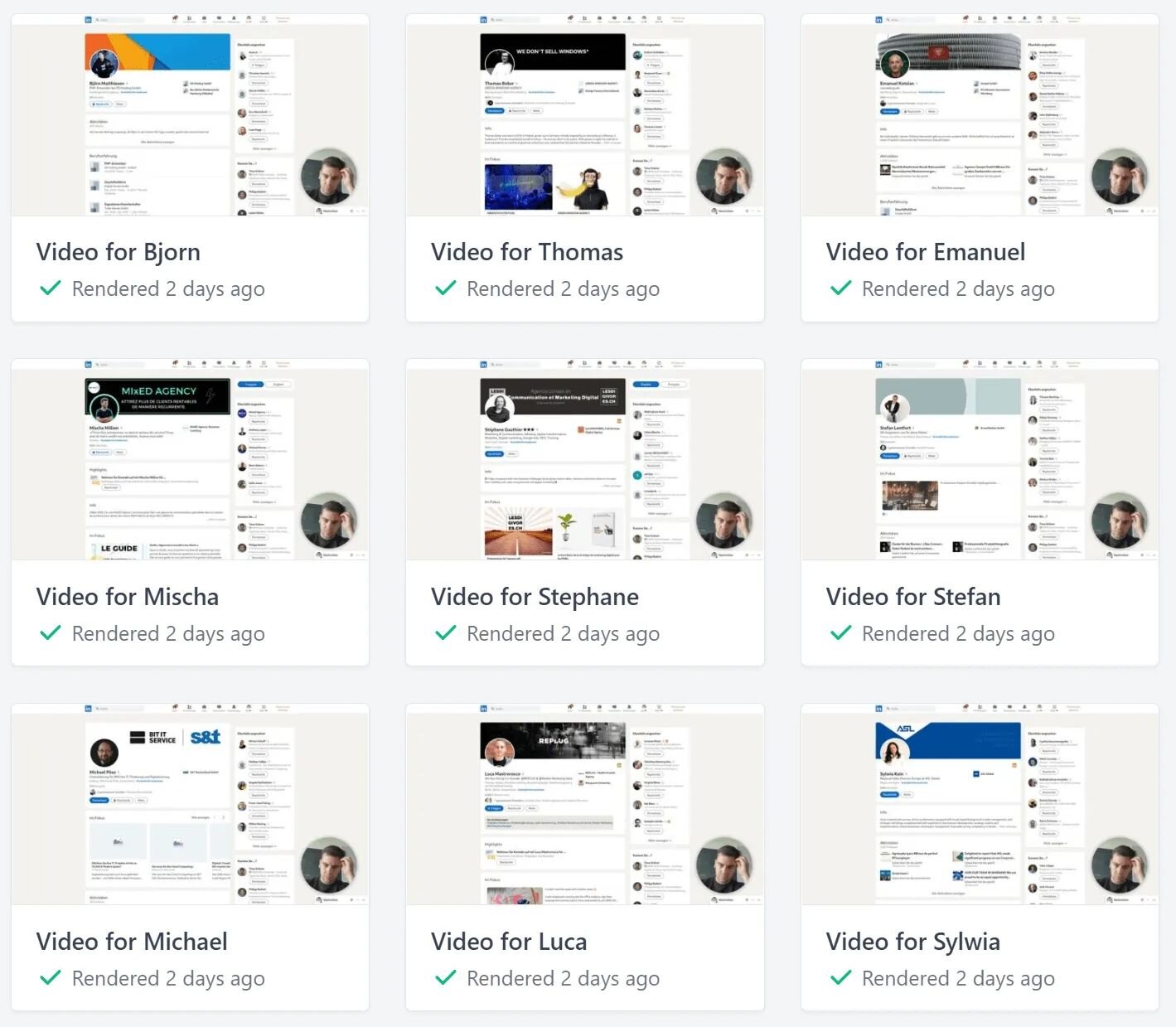
The results people report are why we rank it here. Safwan went from a 1% to a 6% positive reply rate. Bram booked 18 meetings from 140 contacts. Maarten closed $20,000 in three weeks. Those are individual campaigns, and yours will differ, but set them next to 0.45% and you’ll see why it’s worth one test. We’ve written the full video prospecting playbook separately.

4. Cold call, if you can get good at it
Going by Gong’s 300 million calls, a good rep books a meeting about every 45 dials. An average rep needs about 402. At 30 to 40 dials an hour, that’s about 1.3 hours per meeting against 11.5. No other technique rewards skill so heavily, so the honest advice is to go all in or leave it alone.
Data accounts for part of that gap. Cognism, which sells phone data, reports its SDRs reach a 13.3% answer rate using verified numbers. The rest is craft: mark bad numbers, prioritize direct lines, and open with why you called. The industry’s 2.7% call success rate is what happens otherwise.
5. Connect cold on LinkedIn, and skip the pitch in the note
Expandi’s data across 13.2 million requests shows 28.5% accepted, 10.4% of messages getting a reply, and just 3.0% of connection notes getting a response. Multiply the first two and about 3% of your original audience replies, which isn’t so far from email once the denominators match. The note itself barely does anything. So send a short one, or none, and save your pitch for after they accept. LinkedIn caps your volume, and it can restrict you suddenly, so keep this for your top accounts.
6. Clone your best customers
Salesmotion’s customer-lookalike lists drew 0.6% human replies against 0.3% for an ordinary list. It’s a small sample, but doubling your rate by changing who you email costs nothing and takes an afternoon. Pull your ten best customers, run them through GetLeads, which searches by title, industry and company size and gives you 1,000 free credits to do it with (Apollo or Clay if you’re already paying for them), and send to those first.
7. Use signals to pick who, and stop expecting them to write your email
Signals are the most oversold idea in outbound right now. Digital Bloom’s widely shared data says timeline hooks hit 10.01% reply rates against 4.39% for problem hooks. Salesmotion ran hiring-trigger emails to 459 leads and got zero human replies, and new-in-role triggers to 630 leads and got 0.8%. Both samples are small, and they point the same way: a signal tells you whom to contact this week. “Congrats on the funding” tells the prospect you have a Clay table.
New-in-role is the one we’d pay for. New leaders do change their stacks, and you’ll be early.
8. Plain cold email, kept short
Yes, this far down. Cold email’s strength is that it reaches anyone at almost no cost, and that’s also why every inbox is full of it. A realistic 1% human reply rate turns a 1,000-email send into ten humans, some of them telling you to go away. Belkins’ 0.45% floor makes it four or five.
It still deserves a place, since nothing else reaches your whole market. Keep it under 80 words, with 4 to 7 touches, and keep bounces under 2%. Ask one question, and make sure your complaints stay below 0.10%. Our guide to cold outreach has the mechanics, and our quick question generator will give you a first draft of the ask.
9. Stack channels into one sequence
Cognism reports 3.36 touches per prospect across email and phone, with 16.06% of contacted prospects booking a meeting. That’s their own team with their own data, so read it as a ceiling, but the design is the lesson. Email first, connect on LinkedIn on day 3, call anyone who engages. Channel stacking multiplies whatever you already have, so it ranks low only because it needs numbers 1 to 8 working first. Ask a rep to run all three without a working message and you’ve just tripled the ways of being ignored.
10. AI-written first lines
“Loved your recent post about scaling!” Everyone’s prospect now receives four of these before lunch. The AI first line has become a merge tag, and buyers read it the way they read Hi {{first_name}}. The compliments are usually wrong in small ways, which is worse than saying nothing.
Use AI to sort your list, research your segments and draft your follow-ups. Don’t use it to pretend you read someone’s blog.
Techniques to drop
Buying a bigger list. Every contact you burn is one you can’t get back, and your market is smaller than your sequencer thinks. Our B2B prospecting strategy page does the maths on this.
Judging campaigns by open rate. Belkins turned open tracking off for its entire study. Count human replies and meetings held.
Prospecting “rules” with no data behind them. We couldn’t find a source for the 3-3-3 rule or the 5 C’s. Someone wrote them down once, and now they’re everywhere. Run your own test.
Which sales prospecting method should you test next?
Compare email, phone, LinkedIn, referrals and video on the only thing that matters to you, which is meetings held per hour of effort, on your own list. Give each one four weeks and one owner.
If you’ve got no pipeline at all, start with 1 and 2 this afternoon, then set up a campaign using our step-by-step B2B sales prospecting guide. If you’ve got a sequence running and it’s going quiet, test 3 against it on the same segment, because it’s the quickest way to find out whether the problem is your list or your format. If your people like the phone, invest in 4. For what to buy along the way, see prospecting tools and sales outreach tools.
Run the test that ranks third
Number 1 and number 2 cost nothing, so do those first. Then take the segment your cold email has been failing on and try Pitchlane free for 14 days: 250 videos, one recording, your existing sender. You’ll know within a month whether we’ve ranked it too high.
Questions
Frequently asked questions
What are the most effective sales prospecting techniques?
Customer introductions first, LinkedIn messages to people who already know you second, and personalized video to your cold list third. Then the phone for reps who are good at it, cold LinkedIn requests, lookalike lists, and signals for timing. Plain cold email ranks eighth and AI-written first lines last. The ranking follows return per hour, measured in human replies and meetings held.
What are the main methods of prospecting in sales?
Referrals, LinkedIn, cold email, cold calling, personalized video and events, usually stacked into one sequence. The useful split is warm against cold: referrals and your network return 10% or more in human replies, while list-based cold email returns about 1%. Most teams spend the most on the method that returns the least, because it's the easiest to scale.
Which prospecting method is best: email, phone or LinkedIn?
Whichever one reaches people who already know you. LinkedIn messages to an existing network drew 11.3% human replies in one team's data, against 0.3% for list-based email. For strangers, email with personalized video reaches the whole market at pennies a lead, and the phone wins only for top-quartile callers, who need about 45 dials per meeting against 402 for average reps.
What is a good cold email reply rate?
About 1% in human replies is realistic, and anything clearly above it is good. Belkins' 0.45% across 7.5 million emails, auto-replies removed, is the floor. Instantly's 3.43% average counts every reply including automatic ones on its own platform, so check how any benchmark counts before you compare yourself to it. Judge on humans and meetings, never opens.
How many follow-ups should a prospecting sequence have?
Three, making four to seven touches across all channels. Instantly found 4 to 7 touchpoints perform best, with 58% of replies arriving on the first email and 42% on follow-ups. Each follow-up should change the angle or offer something useful. The 8-to-12-touch rule is folklore, and past seven you're mostly raising your complaint rate.
Does cold calling still work?
Yes, for reps who are good at it and have direct numbers. Gong's data implies about 45 dials per meeting for top-quartile reps and about 402 for average ones, so it's the technique with the widest gap between skilled and average. Go all in with verified numbers and coaching, or leave it alone. A half-hearted calling block is the most expensive hour in sales.
Does video prospecting actually work?
Yes, and it's the technique we'd test first on a cold list that's going quiet. Pitchlane plays one recording over each prospect's own website, at about 13 cents a lead. Safwan went from a 1% to a 6% positive reply rate and Bram booked 18 meetings from 140 contacts. Those are their campaigns, so run yours on one segment and compare human replies after a month.
Is AI good for sales prospecting?
For sorting lists, researching segments and drafting follow-ups, yes. For writing first lines, no. Every prospect now gets several "loved your recent post" openers a day, and buyers read them like a merge tag, often with small errors that are worse than saying nothing. Use AI to decide who to contact and when, and let a human voice carry the message.
How do you prospect with no network and no referrals?
Clone your best customers and send them video. Pull your ten best accounts, find firmographic matches in GetLeads, and send a sequence with your recording over each prospect's website. Lookalike lists doubled human replies in one team's data, and video is the fastest way to look unlike the other 40 emails. Start building the network in parallel on LinkedIn.
What are the best prospecting techniques on LinkedIn?
Message people who've viewed your profile or engaged with your posts every Monday, with something useful and no pitch. For cold requests, keep the note short or skip it: across 13.2 million requests, 28.5% were accepted but only 3% of notes got a response, so the conversation starts after acceptance. Save LinkedIn for top accounts, since it caps volume and restricts suddenly.
How do you measure sales prospecting effectiveness?
Meetings held per hour of effort, on your own list, with one owner per method for four weeks. Count human replies and watch bounces under 2% and spam complaints under 0.10%. Ignore open rates; Belkins switched open tracking off for its whole study. Compare methods on the same segment, otherwise you're measuring the list, not the technique.