
Video Prospecting Tools: Your Real Choice Is Takes, Avatars or One Recording
By Pitchlane team · March 13, 2024 ·
For outbound, the best video prospecting tool is the one that lets you record once and still put each prospect’s own website on screen. That’s Pitchlane, and it’s why we built it. Every other video sales tool on your shortlist makes you pay in one of two ways: a human records every take, or an AI copy of that human does it for them.
Feature grids hide this. Loom, Vidyard and BombBomb all have recording, sharing pages and view tracking, so they look interchangeable until you ask what happens at lead 501.
The three kinds of sales video software
Prices as of November 2026.
| Tool | How a video gets made | What changes per lead | Price | Built for |
|---|---|---|---|---|
| Pitchlane | One real recording, rendered per lead | Website or LinkedIn profile behind you, thumbnail/GIF, landing page, plus name in email and title | $37/month for 250 videos, $67 for 500 | Outbound teams and agencies on a sequencer |
| Hippo Video | Recording plus automated personalization | Name, image, text, website or LinkedIn background | $20 to $80 per user/month, capped at 100 to 500 videos per user | Sales teams buying by seat |
| Vidyard | Hand recording, or an AI avatar of you | Whatever the avatar script says | $59 per seat/month annually, $89 monthly, plus $24 to $29 per seat for Video Agent | CRM-led SDR floors |
| HeyGen | Generated avatar and cloned voice | The script | $29/month for 600 credits, Business from $149 plus $20 per seat | Marketing and training video |
| BombBomb | Hand recording | You record it again | $36 per user/month annually, $42 monthly | Relationship sellers |
| Loom | Hand recording | You record it again | Free for 25 videos, then from $18 per user/month | Internal async video |
Sort that table by how a video gets made and the market falls into three groups. Hand recorders sell you a camera button. Avatar tools sell you a synthetic you. Record-once tools keep your real face and voice and change the context around them, which is where Pitchlane and, at lower per-seat caps, Hippo Video sit.
What each approach costs at 500 leads
Take a campaign of 500 leads and be generous about hand recording: three minutes per video to record, redo the fluffed one, upload it and paste the link. That’s 25 hours of someone’s week, every campaign. An SDR on a hand recorder hits the wall around lead 40 and quietly starts sending generic takes, which defeats the point of having bought the tool.
The money looks like this for three people sending:
| Setup | Monthly cost | What you get |
|---|---|---|
| Vidyard Starter, 3 seats, annual | $177 | Unlimited recording, and 25 hours of recording per campaign |
| Vidyard Starter + Video Agent, 3 seats, annual | $249 | Unlimited AI videos, featuring an avatar of the rep |
| BombBomb Core, 3 seats, annual | $108 | Same 25 hours |
| Hippo Video Teams, 3 seats, annual | $180 | 900 personalized videos |
| Pitchlane | $67 | 500 videos from one recording, however many people do the sending |
Now put it against outcomes, using honest numbers. A realistic cold email campaign gets about 1% human replies. Belkins measured 0.45% across 7.5 million emails, replies divided by everything sent, and that’s the floor. Vendor benchmarks run higher (Instantly reports 3.43%) because they count every reply, auto-responders included, on campaigns run through their own platform. So on 500 plain-text leads expect five conversations, and the whole job of video is to make it ten or fifteen. Safwan went from 1% to 6% positive replies, and Hoani books 5% of his leads into meetings, which on this list would be 25 meetings at under $3 of video cost each. At a much duller 1% meeting rate, you’re still paying $13.40 a meeting, and one closed deal covers the year. Run your own numbers in the cold email ROI calculator.
The tools, and where each one falls down for outbound
Pitchlane: one recording, every lead gets their own video
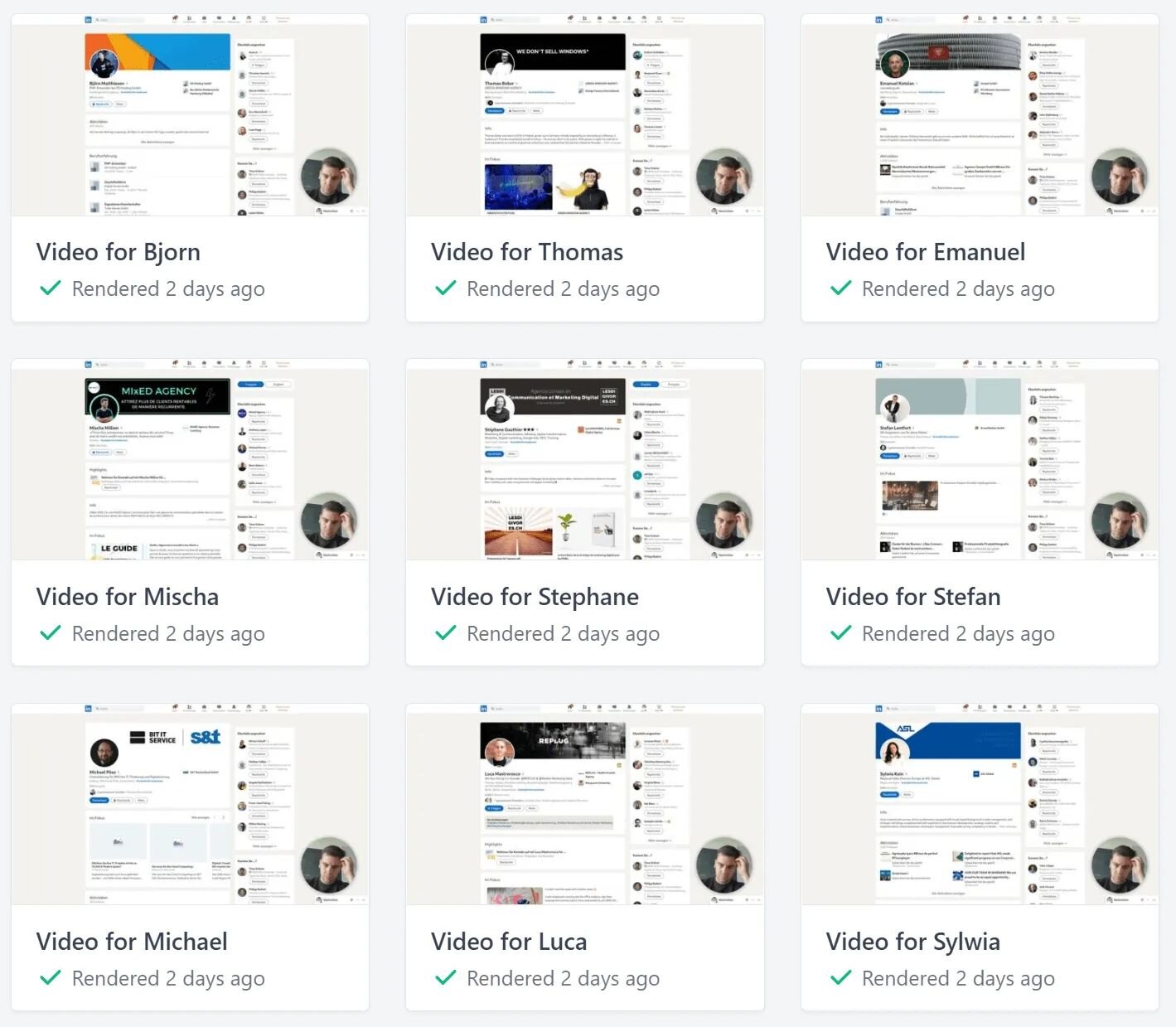
You record the pitch once. Pitchlane renders a version per lead with your recording in a bubble while that prospect’s website or LinkedIn profile scrolls behind you. Each lead also gets a branded landing page with calendar booking, plus a personalized thumbnail or GIF for the email. Their name goes in the email and the video title. The video itself doesn’t say their name, on purpose: it’s your actual voice, 1,000 times, with nothing synthetic for a prospect to catch.
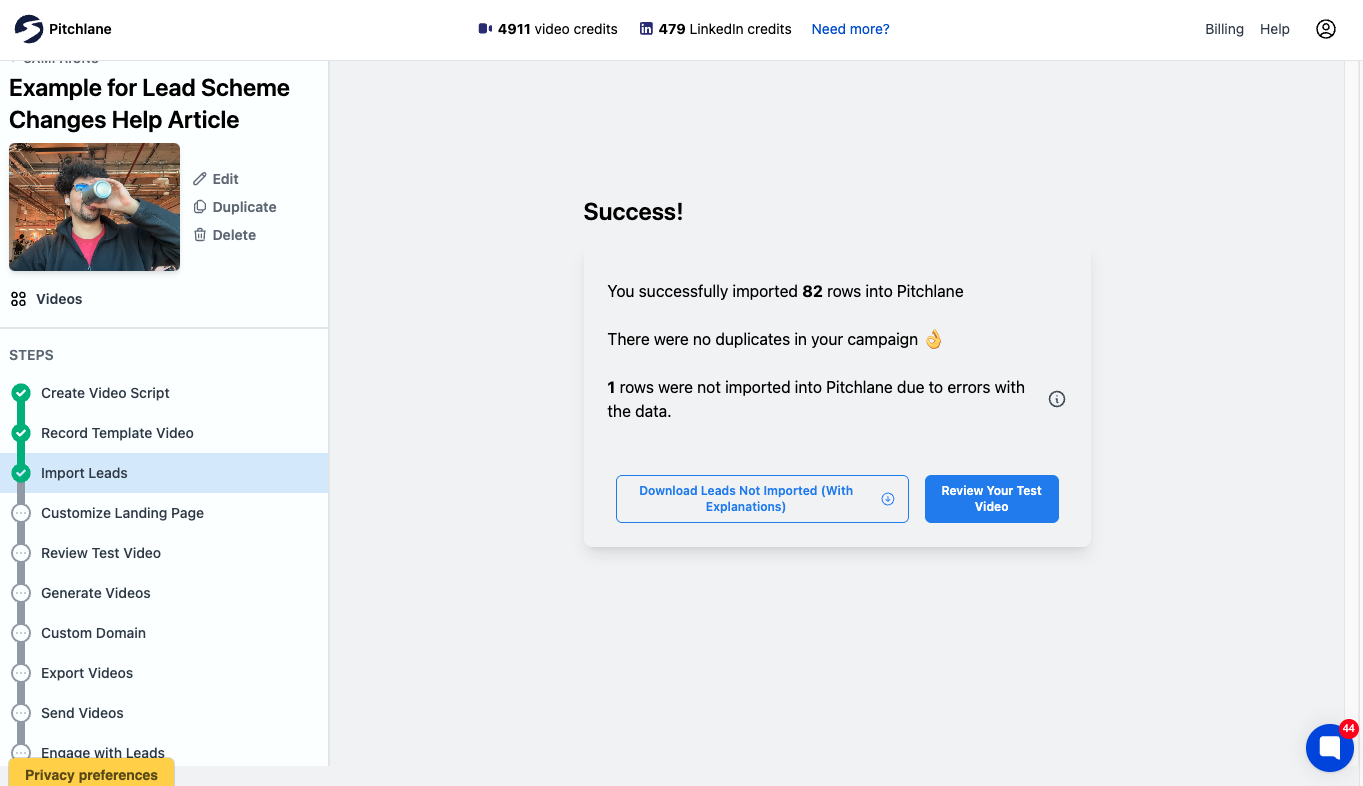
Lead import reports what it rejected, so you find bad rows before they become broken videos. In a real 83-row import, 82 were accepted and one was flagged for a data error, with the details ready to download and fix.
Safwan went from 1% to 6% positive replies. Bram got 18 meetings from 140 contacts. Those are their campaigns and their offers, and they’re also what the top of this category looks like when the list and the pitch are right.
Vidyard: a good recorder with an avatar bolted on for scale
Vidyard is a recorder with hosting and analytics on top, priced per seat, so a 20-rep team pays for 20 recorders even if three people do most of the sending. Its answer to scale is AI Avatars: train it on a 90-second video and it generates a likeness that reads a script with keywords swapped per recipient, at up to 10 minutes of processing per minute of video. Vidyard’s integration pitch leads with HubSpot, Salesforce, Salesloft and Marketo, which tells you who it’s for.
Our objection is to the avatar in a first touch. Cold outreach runs on the prospect believing a person is behind the message. A generated version of you is one bad mouth movement away from proving there isn’t.
Hippo Video: the same idea, sold by the seat
Hippo Video does website and LinkedIn backgrounds, and its free tier includes 50 automated videos a month. Past that, the caps follow the user: 100 videos per user on Pro, 300 on Teams, 500 on Enterprise with a 10-seat minimum. That pricing suits a team where everyone sends a little. Agencies and small outbound teams send a lot from very few people, and they’d be buying seats to get video volume.
HeyGen: impressive technology pointed at the wrong job
HeyGen makes excellent avatars and it’s a serious product for training, marketing and localization. Credits vary by model and length, so you’ll model the bill per campaign. For cold prospecting it has the avatar problem at full strength, plus nothing built around a lead list, a sequencer or a booked meeting without you wiring it up. GTM engineers can make that work through the API. Ask yourself whether that’s the pipeline you want to maintain.
BombBomb: for sellers whose list fits on a whiteboard
BombBomb has Gmail and Outlook plugins, Chrome and Edge extensions, and iOS and Android apps, and its marketing names mortgage, real estate, home builders and automotive. That’s a seller with a relationship book recording to known people from their phone. It’s strong at that. A cold list of 2,000 is a different sport.
Loom: the best internal tool on this list
Loom is the default for async team video and it’s very good at it. Its free Starter plan gives you 25 videos per person at five minutes each. Then it’s a screen recorder doing outbound: every prospect means another take. Our Loom alternative comparison comes down to that one fact.
Which video prospecting tools integrate with email and CRM?
All of them claim to, so ask what the integration does. Hand recorders put a link in the email you’re writing. That’s fine for one email and useless for a campaign with 500 rows.
Pitchlane produces per-lead links and GIFs for your sender to merge in. Smartlead and Instantly are direct integrations that add leads straight into your campaign. lemlist, HubSpot, Apollo, Saleshandy, Expandi and 20+ others connect through CSV, webhook or Zapier, and there’s a REST API for anyone wiring it into Clay or their own stack. Your sender keeps sending, so your mailboxes, warmup and sequences stay where they are. For the rest of that stack, see our breakdowns of outreach tools and email prospecting tools.
Which tools track sales video best?
Every tool here reports views. Treat that as a timing signal for the next follow-up and judge the campaign on replies and meetings. Pitchlane sends views, plays and clicks back so you can see who engaged by lead, then you act on it in your sequencer. Vidyard has the deepest watch analytics of this group, and they matter a lot more to a marketing team tuning a video than to an SDR who needs to know who to call today. The video prospecting playbook covers what to do with the signal.
Can you automate personalized sales video outreach?
Yes. With Pitchlane the full chain runs without a human per lead: Clay or Apollo builds the list, the import or API brings in each lead’s website, Pitchlane renders the videos, and Smartlead or Instantly sends them with the GIF and link merged in. A webhook or Zapier step can trigger the same flow on new leads.
Keep a human on two things: the segment and the test video. A bad recording automated across 5,000 people is an expensive way to annoy a market, so watch one rendered video and check the rejected rows before the batch goes.
The cheapest way to settle this
Take your next list, pick the 250 leads you’d otherwise send a plain sequence to, and record one 60-second pitch. Your 14-day trial includes 250 videos. You’ll be looking at rendered videos the same day, and your sequencer will tell you within two weeks whether your hand recorder was worth keeping.
Questions
Frequently asked questions
What is the best sales video recording software?
For recording one video at a time, Loom has the least friction and BombBomb has the best inbox plugins. For recording once and sending to a whole list, Pitchlane. The second is the one that changes your numbers, because the recording was never the bottleneck.
What software do salespeople use with video?
A typical outbound stack is Apollo or Clay for data, Pitchlane for the videos, Instantly or Smartlead for sending, and HubSpot or Salesforce as the CRM. The video tool produces a per-lead link and GIF; the sequencer merges them in and does the sending.
What are the best video tools for sales and marketing?
They are different purchases. Marketing needs hosting and attribution for a few videos seen by many people, which is Wistia territory. Sales needs thousands of videos each seen by one person, which is Pitchlane. One tool for both usually means a marketing platform your SDRs avoid.
What is Vidyard used for?
Recording, hosting and sharing business video, with analytics and integrations into HubSpot, Salesforce and Salesloft. Sales teams use it for one-to-one follow-up video, marketing teams use it for hosting, and it now sells AI avatars plus an automation add-on called Video Agent for generated video at volume.
What is the difference between a sales video message and a video sales letter?
A video message goes to one prospect, usually by email or LinkedIn, and runs about a minute. A video sales letter sits on a page and pitches everyone who lands there, often for many minutes. VSL tools care about funnels and split tests, and none of them put a prospect's website behind you.
What are the best video prospecting tools?
Pitchlane for anyone sending to a list, because one recording becomes a personalized video for every lead, with their own website on screen. BombBomb if you record one message at a time from Gmail or Outlook, and Loom if the video is really for your own team. Vidyard and HeyGen cover scale with AI avatars, which we would keep out of a cold first touch.
Which video prospecting tools integrate with email and CRM?
All of them claim to, so ask what the integration does. Hand recorders put one link in the email you are writing. Pitchlane produces a link and GIF per lead and adds leads straight into Smartlead or Instantly campaigns, with lemlist, HubSpot, Apollo, Saleshandy and 20+ others connected by CSV, webhook or Zapier, plus a REST API for Clay-style stacks.
How much does video prospecting software cost?
Per video or per seat, and the unit decides your bill. Pitchlane is $37 a month for 250 videos and $67 for 500, whoever does the sending. Vidyard Starter is $59 per seat on annual billing and $89 monthly, BombBomb $36 to $42 per user, Hippo Video $20 to $80 per user with a video cap per seat. Three seats on Vidyard cost more than 500 Pitchlane videos.
Are there free video prospecting tools?
Free recorders, yes: Loom gives you 25 videos per person and Vidyard five recordings a month. Hippo Video includes 50 automated videos on its free tier. None of them carry a real campaign, which needs a few hundred leads before the reply rate means anything. Pitchlane runs a 14-day trial with 250 videos instead, which is enough to read a result.
What is the best video prospecting tool for agencies?
Pitchlane, because agencies send high volume from very few people and per-seat tools charge for exactly the wrong thing. One recording per client campaign renders a video for each prospect, the landing page carries the client brand on a custom hosting domain, and the links drop into whichever sequencer the agency already runs for that client.
Loom vs Vidyard for sales: which is better?
Vidyard, if you have to pick between the two for outbound, because it has sharing pages, watch analytics and CRM integrations that Loom lacks. Loom is cheaper and the better tool for internal async video. Both are still hand recorders, so every prospect means another take, and neither puts a prospect-specific background behind one recording the way Pitchlane does.